
Calculate the voltage drop of a cable.
Current, length, cross-section, conductor metal and power factor: this tool calculates the voltage lost along a cable. It does not validate the cross-section on its own; that remains an engineer’s job.
This calculation checks neither the current the cable can carry nor its protection: an engineer must verify both before any choice.
Assumptions: resistivity of 0.0225 Ω·mm²/m for copper and 0.036 for aluminium (conductor in service), reactance of 0.08 mΩ/m.
Request a studyVoltage drop, in plain terms
A cable is not a perfect conductor: it resists the current, and part of the voltage is lost along the way. The equipment at the far end therefore receives a little less than what leaves the switchboard. This loss increases with the current and with the length of the cable; it decreases as the cross-section increases. For the same cross-section, copper conducts better than aluminium, which is why the choice of metal is one of the inputs.
This loss has practical effects. A motor supplied at too low a voltage starts with more difficulty and heats up more. Lighting loses brightness. The issue arises above all over long distances: outdoor lighting, a pumping station, a building far from the transformer substation. The allowed drop is not left to each person’s judgement: it is set by the standards in force and by the project specification.
What the tool does not check
Voltage drop is only one of the criteria that determine a cross-section. The cable must also carry the current without heating up beyond what its insulation allows, which depends on how it is installed, on the ambient temperature and on the proximity of other cables. Lastly, it must be protected by a suitable device against overloads and short circuits. The tool checks neither of these two points.
A cross-section that gives an acceptable voltage drop is therefore not a validated cross-section. In a design calculation, the engineer checks all the criteria and selects the cross-section that satisfies them all together. Use the result to understand an order of magnitude, compare two routes or prepare a question, then have the choice confirmed by a design office or by the contractor in charge of the works.
To have checked by an engineer
- The current the cable can carry in its installation conditions
- Protection against overloads and short circuits
- The voltage drop when motors start
- Compliance with the standards in force and with the specification
A model of principle: typical equipment, not the mock-up of a particular installation.
Your questions
01What can be done if the voltage drop is too high?
There are three options: increase the cross-section of the cable, shorten the route by moving the switchboard closer to the equipment, or spread the load over several circuits. The choice depends on the site and on the cost of each solution; the study decides, checking the other criteria at the same time.
02Copper or aluminium: what difference does it make?
Aluminium conducts less well than copper: for the same voltage drop, it needs a larger cross-section. It is, on the other hand, lighter. Connecting it requires accessories designed for this metal. The choice between the two is made at the study stage, according to the link and the budget.
Read next
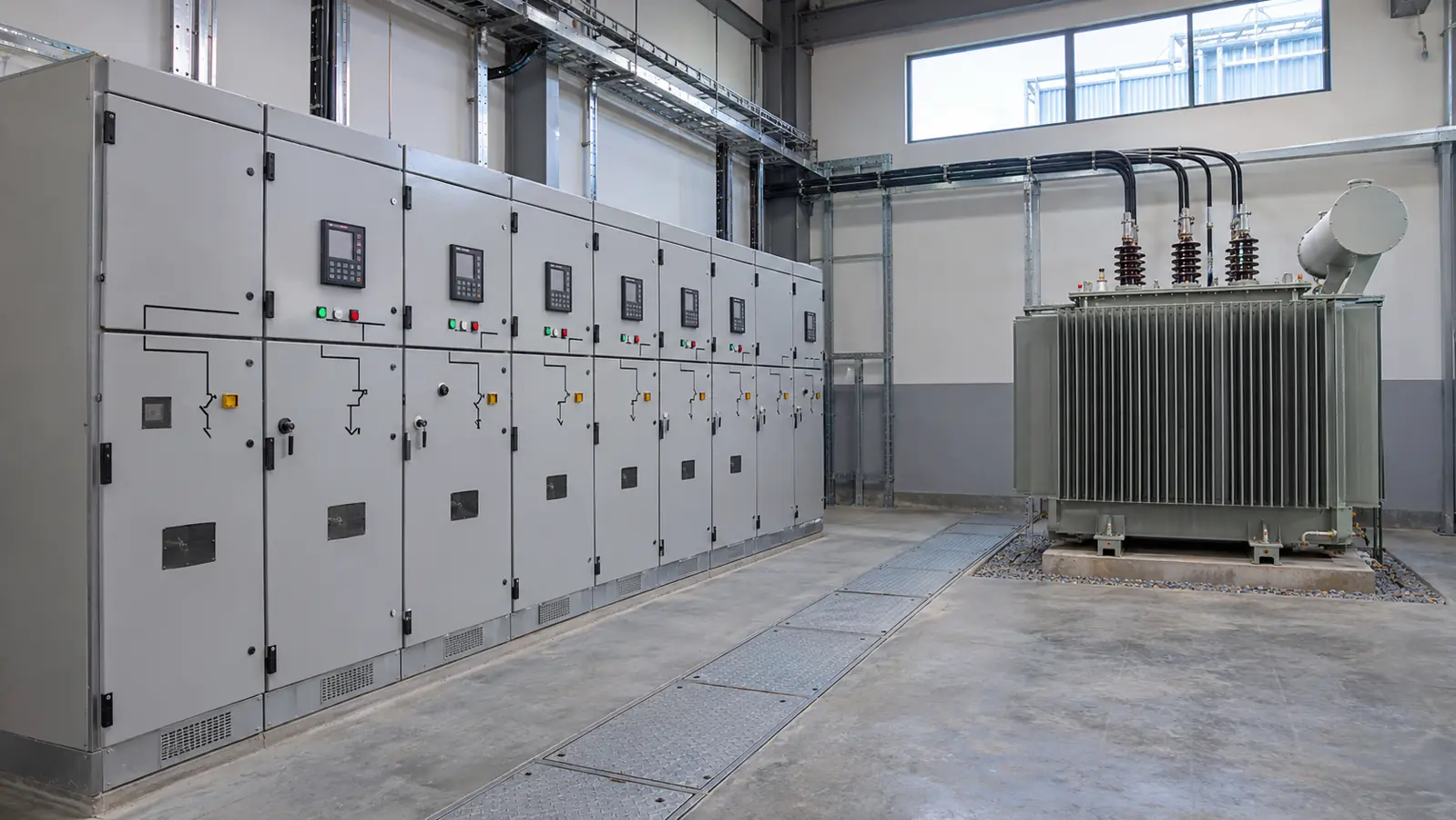
Running a transformer substation project
Who decides what, when and with whom: this guide follows a transformer substation project as the client experiences it, from the first power estimate to the handover of the documentation.
Read the guide
A store’s electrical work package: the checklist
In All Africa (IN2A) has delivered the electrical work package of several Decathlon stores in Morocco. This checklist sets out, in the order of the project, what the person in charge of an opening has to decide, follow, check and keep.
Read the guide
Choosing your electrical contractor
References, design, team, tests, maintenance: the questions to ask before entrusting an industrial or commercial project to an electrical contractor, and how to compare quotes that do not all cover the same thing.
Read the guideRelated services
The In All Africa (IN2A) trades linked to this subject.
A link to have sized?
A work package to price, a substation to renovate, a home to equip: tell us what you need and we will get back to you.
- +212 522 212 298
- commercial@inallafrica.com
- 86, lot. Mandarouna, rue 23, Aïn Chock, Casablanca