
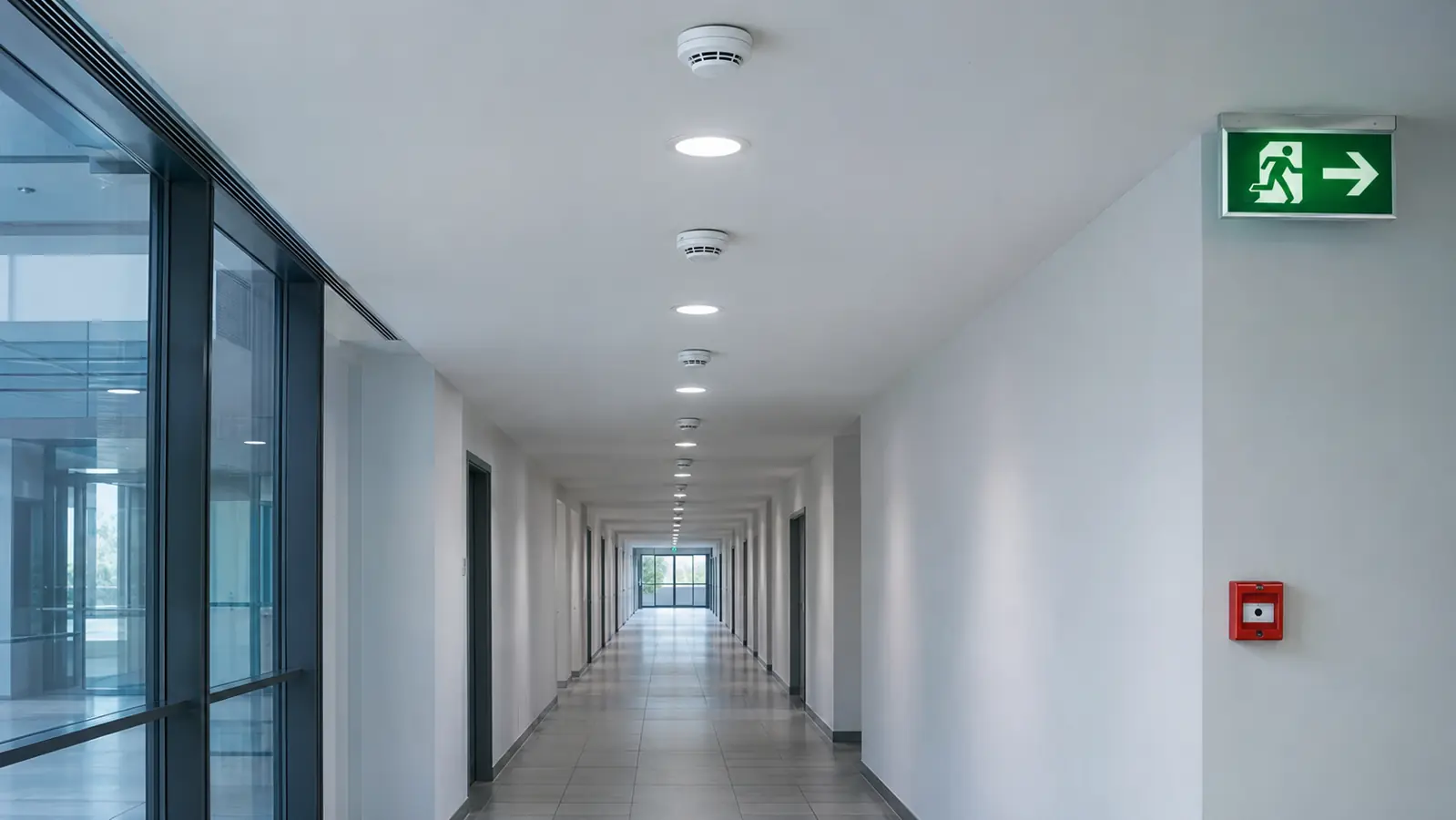
Detect early, alert clearly, make the site safe.
In All Africa (IN2A) installs, connects, commissions and maintains your fire detection and fire safety control equipment.
How a fire safety system works
A fire safety system (SSI) has two roles: to spot the start of a fire as early as possible, then to trigger the actions that protect the occupants and the building. It is most often made up of two subsystems.
The fire detection system (SDI) monitors the premises and raises the alert. The fire safety control system (SMSI) receives this information and controls the alarm, the emergency lighting and the shutdown of the technical installations.
- Detectors and call points
- Control and indicating panel (ECS)
- Safety control unit (CMSI)
- Audible alarm
- Safety actions
A model of principle: typical equipment, not the mock-up of a particular installation. Schematic diagram: it shows how the parts follow one another, not the drawing of a particular installation.
Detection: the SDI
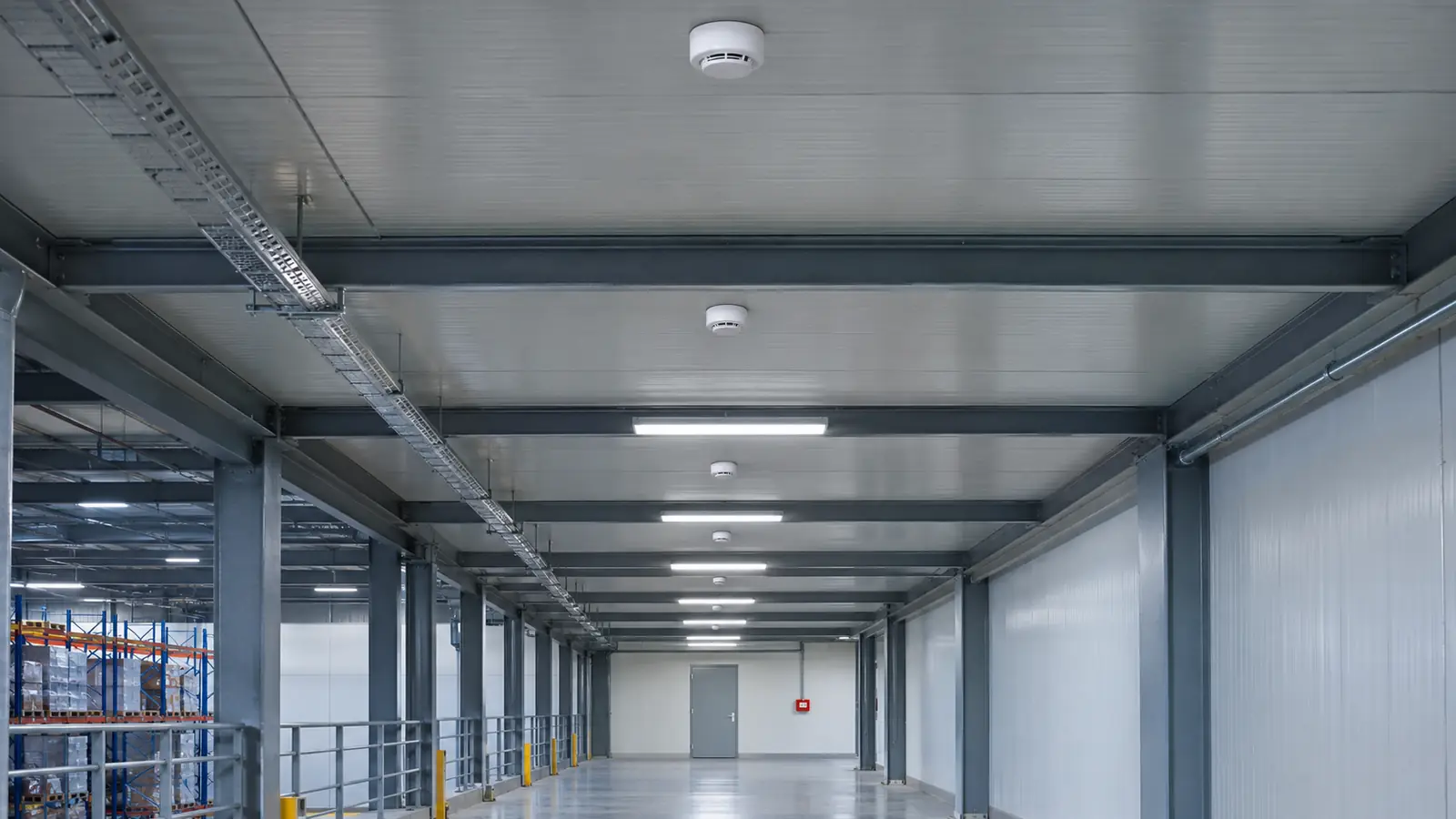
In All Africa (IN2A) installs, connects, commissions and maintains the equipment of the fire detection system. The choice of detectors depends on the premises to be protected and the risks they present.
Detection equipment
- Optical flame or smoke detectors
- Fixed-temperature or rate-of-rise heat detectors
- Multi-sensor detectors
- DAAF (standalone smoke detectors and alarms)
- ECS control panel (control and indicating equipment)
Making safe: the SMSI
We also deploy and maintain the associated fire safety control equipment, which takes over as soon as the alert is raised.
Fire safety control equipment
- CMSI (fire safety control panel)
- Emergency lighting and standby lighting
- Alarms and audible alarm sounders
- Technical shutdown devices: lifts, ventilation
Installing fire detection in a new or occupied building
In a new building, fire detection is designed with the drawings: each room receives the type of detector suited to its use and its risks, and the alarm sounders are spread out so as to be heard everywhere. The control panel is installed where staff can consult it quickly, generally at reception or at the security post.
In an occupied building, the installation is carried out without interrupting the activity: the cables follow the existing routes, the works progress area by area, and the system is commissioned once everything is connected. When a site grows, detection is extended to the new rooms if the panel in place can take them; if not, it is replaced. Among other projects, In All Africa (IN2A) delivered the fire detection work package of an industrial building for ISTC, in Casablanca.
Common situations
- New building: industry, retail, education
- Extension of a site already equipped
- Replacement of an old system
- Adding detection to an occupied building
- Maintenance of an installation in service
Testing, commissioning and maintenance of an SSI
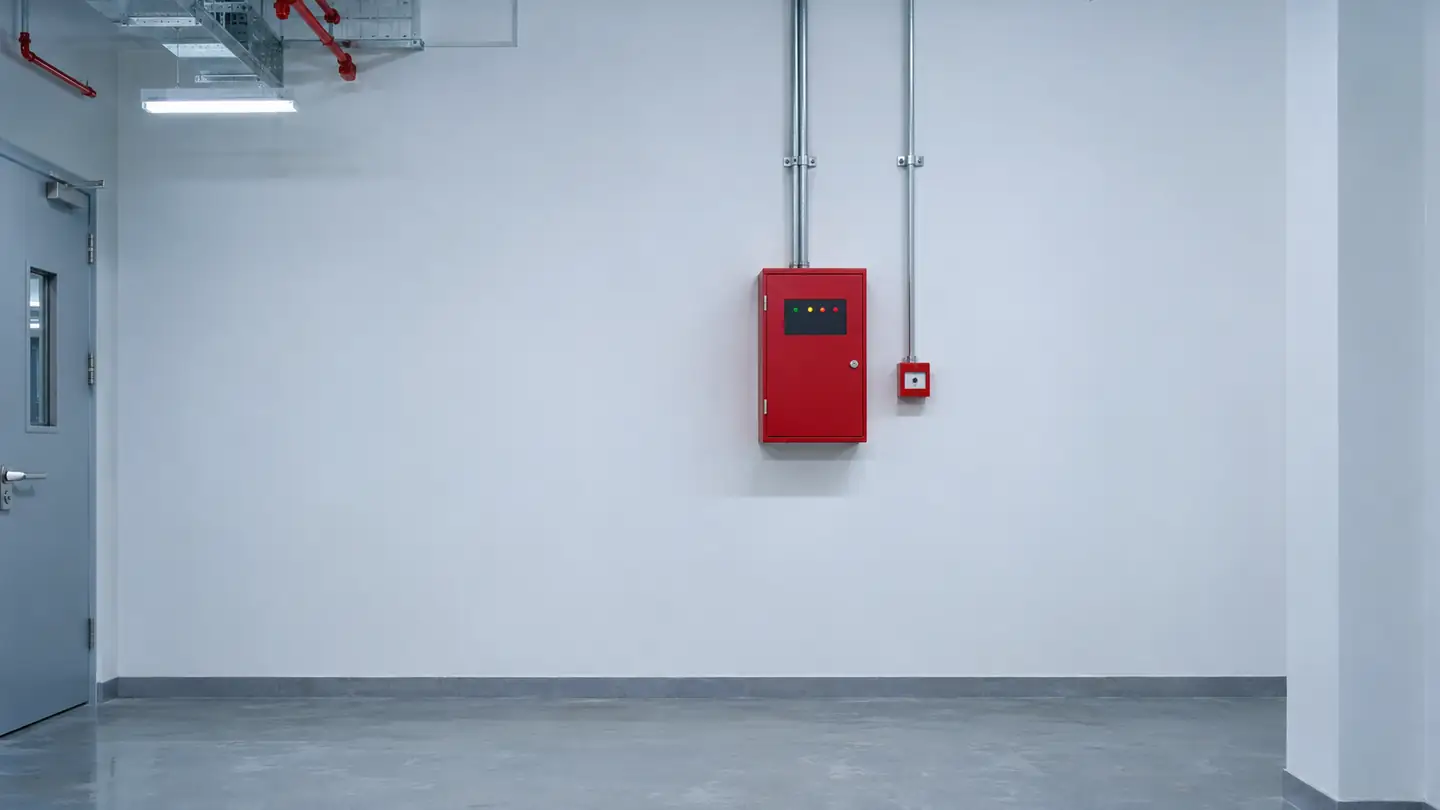
A fire safety system is only worth having if it works on the day it is needed. Before handover to the client, each detector is tested and we check that the alert reaches the panel with the correct zone identification. The actions controlled by the system are tested one by one: sounding of the alarm, emergency lighting, shutdown of the ventilation and the lifts where they are linked to the system.
Over time, dust, the moving of partitions or a change in the use of the rooms can make detection ineffective or cause false alarms. Maintenance consists of regularly checking the detectors, the panel and its standby power supply, and adapting the installation when the premises change. In All Africa (IN2A) provides this maintenance, in line with the standards in force and the requirements of the site.
What to send us for a quote
- Drawings of the floors and rooms
- Activity and use of each area
- Existing system and its condition, where applicable
- Requirements applicable to the project, if known
- Technical equipment to be linked to the system: ventilation, lifts
Your project, step by step
From the first site visit to the upkeep of the installation.
Analysis of the premises
We study the drawings, the use of each room and the risks it presents in order to define the zones to be monitored.
System study
We choose the types of detectors, their layout, the control panel and the safety actions to be controlled.
Installation and testing
Our teams install and connect the equipment, then test each detector and each controlled action before commissioning.
System maintenance
We then check the installation over time and adapt it when the premises are refitted or extended.
Our references
Client, scope of work and city, as they appear in our list of references.
Fire detection (SSI): your questions
01What is the difference between SDI and SMSI?
The SDI (fire detection system) detects and signals the start of a fire. The SMSI (fire safety control system) carries out the safety actions: alarm, emergency lighting, shutdown of lifts and ventilation. Together, they form the SSI.
02Does In All Africa (IN2A) maintain fire detection systems?
Yes. In All Africa (IN2A) installs, connects, commissions and maintains fire detection and fire safety control equipment.
03In which buildings have you installed fire detection?
In the Decathlon stores, the EHTP conference hall, the accommodation buildings of the Lycée d’Excellence in Benguerir, the Fenie Brossette manufacturing unit in Tit Mellil, the Axim Maroc production unit in Aïn Sebaâ and an industrial filter-manufacturing building for ISTC.
04Which type of fire detector should you choose?
The choice depends on the room and on the type of fire to be expected. A smoke detector suits most rooms; a heat detector is preferred where smoke, steam or dust are normally present; a flame detector reacts to the radiation of an open fire. The study specifies this room by room.
05What is the ECS panel for?
The ECS, the control and indicating equipment, is the central panel of the fire detection system. It receives information from the detectors, shows the zone where the alert was triggered and reports faults in the installation. It passes the alert on to the CMSI, which controls the safety actions.
06Can an existing fire detection system be extended?
Yes, when the panel in place has the necessary capacity and the new equipment is compatible with it. Otherwise, the panel is replaced and the existing detectors are reused where they can be. A survey of the installation enables In All Africa (IN2A) to decide.
Going further
Related services.
Low-current systems
Networks, safety, building control
Access control and security
Access, intrusion, video surveillance
Public address and sound systems
Safety and ambience
Lighting and LED continuous-row lighting
Indoor, outdoor, LED
Renewable energy
Solar, wind, hydro, geothermal, biomass
Multi-technical maintenance
Keeping your sites in operation
A fire detection system to install?
A work package to price, a substation to renovate, a home to equip: tell us what you need and we will get back to you.
- +212 522 212 298
- commercial@inallafrica.com
- 86, lot. Mandarouna, rue 23, Aïn Chock, Casablanca